
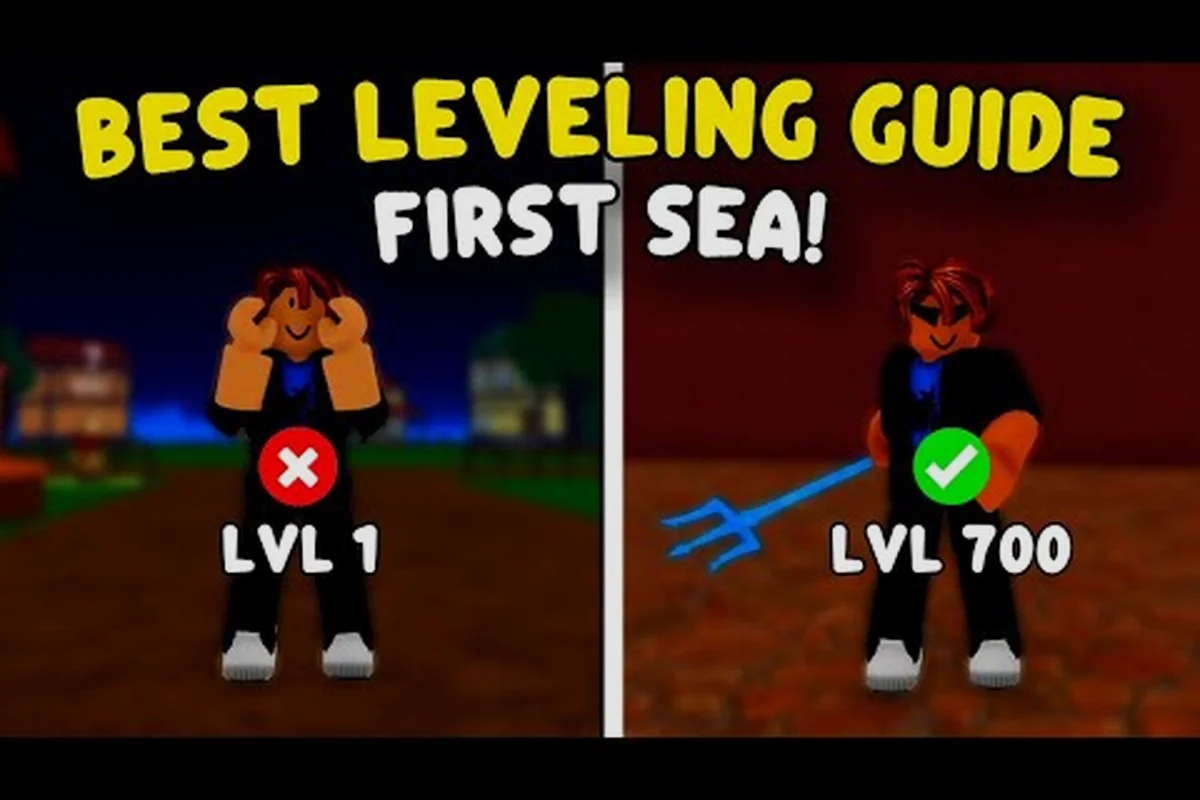
Blox Fruits leveling is fastest when every fight contributes experience, Beli, and useful quest progress. This Blox Fruits leveling guide maps practical routes through the first and second seas, showing which spots fit each level band and when quests are more efficient than grinding.
Blox Fruits Leveling Guide: Start With a Clear Route
A Blox Fruits leveling guide matters because level gates decide which islands, quests, enemies, and bosses become available. Fighting a powerful enemy too early can waste time, while ignoring quest rewards makes progression slower than necessary. The best route combines repeatable combat, story objectives, and occasional boss wins.
Think of leveling as a continuous rotation rather than a single destination. Players who understand how to level up fast in Blox Fruits move to the highest-value activity they can finish consistently. They clear nearby quests first, farm mobs only when the next quest is blocked, and use bosses when they provide both experience and a practical reward.
| Priority | Activity | Best use | Main benefit |
|---|---|---|---|
| 1 | Story quests | Whenever a quest is available | Experience, Beli, and progression |
| 2 | Easy repeatable mobs | Between quest objectives | Steady experience and materials |
| 3 | Quest bosses | When the quest requires one | Bonus progress and useful rewards |
| 4 | Optional bosses | During planned farming sessions | Extra rewards and occasional items |
The leveling loop
The core loop is simple: accept the next available quest, complete its objective, claim the reward, and determine whether another quest can be reached immediately. If not, farm a nearby group until enough experience is earned or the next objective becomes available. This method keeps combat productive without turning every session into wandering between islands.
The community lesson behind Blox Fruits fast leveling is simple: experience per minute matters more than experience per kill. A weak enemy that dies instantly can still be correct if it stands close to the quest objective. The Blox Fruits leveling walkthrough for the first sea also organizes progression around island bands, which helps players avoid farming below the level range they actually need.
Level-band checkpoints
| Progression stage | Suggested level range | Primary destination | Main focus |
|---|---|---|---|
| Starter island | 1–15 | Starter Island | Learn combat and finish the first quests |
| Early first sea | 15–45 | Kingdom of Rose through Log Pose Island area | Story quests and easy mob packs |
| Mid first sea | 45–100 | Green Sea and nearby islands | Quest chains and efficient farming |
| Late first sea | 100–150 | Fountain City | Complete remaining first-sea objectives |
| Early second sea | 150–300 | Kingdom of Rose in Second Sea | New quest progression and stronger mobs |
| Mid second sea | 300–700 | Ice Island, Dark Island area | Build-focused farming and boss attempts |
| Late second sea | 700–1,500 | Forgotten Island area | High-value mobs and endgame quests |
These are broad progression bands rather than strict requirements. Enemy strength and quest availability can change with game updates, so players should use them as routing guidance and verify the current level requirements in game.
Blox Fruits First Sea Leveling: Route Each Island Band
Blox Fruits first sea leveling is most efficient when players follow the intended progression order. The starter island establishes the basic rhythm, Kingdom of Rose introduces fuller quest chains, and later islands become practical only after the relevant level gate is reached. Skipping ahead usually produces slower kills and fewer available rewards.
Beginner island route
Begin with the starter island and complete its basic quests. The goal is not to find the largest possible mob group; it is to learn attack range, enemy telegraphs, combo timing, and how quest progress advances. Players should equip a starter weapon they can afford to maintain and learn the reliable sequence rather than relying on flashy moves with long recovery periods.
| Starter objective | Practical action | Why it works |
|---|---|---|
| Defeat basic enemies | Clear the weakest nearby group repeatedly | Builds accuracy and combat rhythm |
| Complete sword trials | Practice a three-skill combo | Reduces wasted stamina |
| Gather quest items | Follow the marked route | Advances the story without extra travel |
| Reach the next island | Finish required quests | Unlocks the next progression band |
New players who need the broader controls and unlock sequence can use the Blox Fruits beginner guide before moving into a longer farming session. Once the opening objectives are understood, return to the quest route rather than repeating an overly easy area without purpose.
Kingdom of Rose and early questing
Kingdom of Rose is the first major routing checkpoint. Clear its quest chain, identify repeatable enemies, and only then begin a short farm cycle. The best leveling spot is often the group closest to a quest marker because travel can consume more time than the small difference in experience between two enemy tiers.
The important distinction is quest value. An enemy worth 50 experience per kill may be excellent when it stands beside the next objective, while a stronger enemy worth 70 experience can be inefficient if the trip and recovery time are substantial. Clear the objective, claim its reward, and then decide which nearby pack offers the smoothest combat loop.
Mid-first-sea farming
As the first sea route opens up, look for groups that can be defeated with short combos. The strongest Blox Fruits leveling spots are not always the highest-level areas; they are the places where you can kill enemies consistently, recover quickly, and complete several encounters without crossing the map.
Community route guides emphasize a high-value quest rotation, and that advice remains useful because quests also pay Beli and unlock access. You can compare the visual approach in this updated community leveling guide, then adapt it to the quests currently available on your account.
| First-sea route segment | Recommended action | Fallback when blocked |
|---|---|---|
| Green Sea quest line | Finish objectives in order | Farm the nearest pack with fast respawns |
| Castle quests | Defeat the required enemies | Complete a short farm route for experience |
| Pirate Island pressure | Use an efficient mob rotation | Collect quest items between fights |
| Fountain City approach | Finish the final quest chain | Repeat a reliable mid-sea group |
Late first-sea cleanup
Near level 150, avoid switching to Second Sea too early. Complete the final first-sea objectives and use the remaining repeatable quests to secure experience and Beli. A clean transition is valuable because Second Sea starts around level 150, but entering before the first-sea route is finished may leave important rewards incomplete.
Blox Fruits Second Sea Leveling: Farm Efficiently After Level 150
Blox Fruits second sea leveling begins around level 150, when stronger enemies, new quest chains, and different islands become available. The routing principle remains consistent: complete quests, farm where movement is short, and compare experience gained per minute rather than the number displayed under one defeated enemy.
Entering the second sea
After reaching the required level, unlock the Second Sea and collect every quest that can be accepted immediately. This early objective burst can carry a player across several levels before the route settles into a normal grind cycle. Avoid spending that opening window on random bosses unless they directly unlock a quest or fit the planned route. For a broader view of island requirements, consult the guide to all Blox Fruits islands. Checking the intended order before traveling can prevent backtracking and help you determine whether a difficult area is genuinely productive for the current stage.
| Second-sea opening action | Expected benefit | Route priority |
|---|---|---|
| Accept available quests | Unlocks immediate targets | Very high |
| Clear introductory mobs | Provides safe early experience | High |
| Reach the next quest island | Expands the route | Very high |
| Attempt a difficult boss | May unlock later rewards | Medium |
| Repeat the nearest easy pack | Maintains steady progress | High |
Choosing the best leveling spot
A good Blox Fruits best leveling spot meets four conditions: enemies are close together, they can be defeated without long recovery periods, the area is easy to enter, and the route connects naturally to a quest. A spectacular location with scattered enemies may offer more experience per kill but still lose time to searching, repositioning, and restarting after mistakes.
| Spot quality | What it looks like | Why it affects speed |
|---|---|---|
| Excellent | Dense, nearby mobs with quick respawns | Maximizes active combat time |
| Good | A compact group near a quest marker | Saves travel and supports objectives |
| Fair | Separate camps on the same island | Extra walking reduces efficiency |
| Poor | Strong enemies requiring several combos | Longer fights and more damage taken |
| Avoid | Hard-to-reach camps with no quest value | High travel cost and uncertain rewards |
Bosses as route milestones
Bosses can accelerate a segment when they award strong experience, required quest progress, or valuable items. They are not automatically the best option. A difficult boss may consume several attempts without producing a reward, while a nearby mob pack can provide continuous progress.
Use bosses when you can defeat them in a small number of attempts, when a quest points toward them, or when the reward fills a build need. Otherwise, finish the available quest chain first. This is also where the Blox Fruits farming guide becomes useful for selecting a farm that supports your weapon and desired stat path instead of relying on one universal location.
Blox Fruits Fast Leveling: A Practical Session System
Blox Fruits fast leveling depends on preparation before the first enemy appears. Choose the route, gather quest objectives, equip the correct weapons, and decide when to stop. Without a plan, players often alternate between easy and hard areas while missing repeatable quests that provide more total progress.
Prep Work Before a Grind Run
Spend two minutes checking the quest menu and the world map. Identify one main quest, one fallback farm, and one optional boss target. Keep consumables and healing items available, and select a weapon whose damage and range match the current zone. A one-minute setup can save several minutes of inefficient combat.
| Preparation step | Action | Time saved |
|---|---|---|
| Quest audit | Accept and track the next objectives | Prevents unnecessary island hopping |
| Route selection | Choose one farm and one backup | Stops random switching |
| Gear check | Equip suitable weapons and stats | Improves kill consistency |
| Inventory check | Bring food and healing supplies | Reduces avoidable defeats |
| Session target | Set a level or quest milestone | Creates a clear stopping point |
Follow this quest-to-farm cycle
-
Accept the quest that offers the most experience and Beli.
-
Travel directly to its marked location and clear the required enemies.
-
Claim the reward before searching for optional content.
-
Check the next quest and repeat when it is immediately accessible.
-
Farm the nearby group when quest travel would exceed the expected experience gain.
-
Attempt a boss only if it advances a quest or fits a planned reward goal.
This method is more reliable than memorizing a single farm. Quest availability changes as you progress, while the basic cycle remains useful. It also gives the best leveling spot a clear definition: the closest repeatable group that keeps the next objective within practical reach.
Measure time, not just kills
Track how many levels you gain during a 20-minute session, how many quests you finish, and how often you defeat enemies in one attempt. If experience per minute is poor, change one factor at a time. Move closer to the enemies, select a better weapon, complete a quest, or leave a zone where travel consumes too much of the session.
| Symptom | Likely cause | Adjustment |
|---|---|---|
| High damage taken | Farming above the current band | Move to an easier group or improve gear |
| Long empty walks | Unplanned quest rotation | Pick a closer farm and clear one route |
| Frequent retreats | Slow enemy cycles | Reduce enemy density or use a safer zone |
| Plenty of kills but slow levels | Low-value targets | Favor quests and denser mob groups |
| Fast progress with little Beli | Combat-only grinding | Add repeatable quests to the rotation |
Blox Fruits Leveling Spots: Choose by Combat Value
Blox Fruits leveling spots work best when they fit the player’s current objective, combat skill, and available time. A location that is excellent for one account may be inefficient for another because quest progress, equipment, and enemy respawn speed differ. Treat community recommendations as starting points, then test them against the current version.
Dense mob groups versus difficult bosses
Dense groups usually provide the cleanest experience rate because the player can maintain a rhythm. Difficult bosses can pay more in a single victory, but the expected reward must account for failed attempts, travel, healing, and time spent waiting for respawn. For most players, quest value per minute remains the better comparison.
| Target type | Best time to use it | Main advantage | Main drawback |
|---|---|---|---|
| Dense mob group | Between quests | Steady experience and easy routing | Usually less Beli per fight |
| Repeatable quest | Whenever available | Experience, Beli, and story progress | Limited number of objectives |
| Quest boss | When required | Guaranteed milestone and quest value | Harder fight and travel |
| Optional boss | Planned session | Equipment and special rewards | Uncertain attempt rate |
| Sea Event target | During an active event | Temporary high-value rewards | Limited availability |
Build-friendly farming
Some locations support specific builds better than others. Ranged players benefit from spacing and enemy density, melee players need short attack animations and reliable combos, and elemental builds may prefer targets that resist fewer of their attacks. Check the target’s element before committing to a camp.
The Blox Fruits AFK farming guide can help with offline experience planning, but active players should still rotate around quests. AFK farming and direct questing solve different problems: one generates passive progress, while the other usually produces a faster route through difficult milestones.
Handle crowded or contested areas
If another player occupies the best group, do not immediately abandon the location. Look for a second camp with the same level range, or complete the nearby quest and return after a short delay. Consistency matters more than securing one famous spot. If the area is so crowded that enemies are constantly interrupted, choose the less popular alternative.
| Situation | Better response | Avoid |
|---|---|---|
| Camp is crowded | Use a backup camp or complete a nearby quest | Waiting without progress |
| Boss crowd is large | Test another route or return later | Repeatedly losing time |
| Enemy density is poor | Move to a denser group | Wandering the entire island |
| Spot feels slow | Compare experience per minute | Farming by location name alone |
Leveling Route Benchmarks and Common Mistakes
A useful Blox Fruits leveling route has milestones, not only a list of islands. Community references place the First Sea between the starter island and Fountain City, Second Sea between Kingdom of Rose and Forgotten Island around level 1,500, and the next major progression phase from Port Town to Submerged Island near level 2,600. These are route anchors, not guaranteed level gates for every objective.
Track meaningful milestones
| Milestone | Target | Check before moving on |
|---|---|---|
| Starter completion | About level 15 | Initial quests and first island unlocked |
| First-sea progression | About level 150 | Main first-sea quest line available |
| Second-sea entry | Around level 150 | New sea unlocked |
| Mid second sea | About level 700 | Stronger farming route available |
| Late second sea | Around level 1,500 | Forgotten Island route reached |
| Later progression | Near level 2,600 | Port Town through Submerged Island band |
Record your actual progress because quest requirements and update tuning may alter these references. If you need a route beyond the covered seas, the Third Sea leveling guide continues the same method through the 700–1,500 and 1,500–3,000 ranges.
Avoid common leveling mistakes
The biggest mistake is farming below the required range. Weak enemies feel safe, but their low experience means the player needs many more kills to cover the same distance. Another common error is ignoring quests because they require travel. Calculate the total reward before rejecting them; a distant quest with Beli, experience, and access to a new route can be worth the trip.
| Mistake | Why it slows progress | Correction |
|---|---|---|
| Farming too low | Low experience per kill | Match enemies to the current quest band |
| Ignoring repeatable quests | Misses Beli and story rewards | Clear them between farm cycles |
| Changing zones constantly | Travel fragments each session | Use a planned main route and backup |
| Boss rushing | Failed attempts consume time | Use bosses as milestones |
| Playing without a target | Sessions end without clear progress | Set a level or quest goal |
A reliable end-of-session routine
Finish with a quest if one is nearly complete, otherwise bank a partial quest reward only if it does not reduce future progress. Keep enough experience for the next milestone, record the best-performing spot, and leave with a clear first target. This makes the next session begin immediately rather than requiring another ten minutes of planning.
The central lesson of this Blox Fruits leveling guide is that speed comes from sequencing. Quests provide the best combined value, nearby mobs fill the gaps, and bosses fit into the route when their rewards justify the attempt. Use the island bands as checkpoints, measure progress by experience per minute, and change only one variable when a farm stops performing.
Frequently Asked Questions
What is the best leveling spot in Blox Fruits?
The best leveling spot is the nearest repeatable enemy group near an available quest, because it combines fast kills with minimal travel. A slightly weaker camp can outperform a stronger area when it sits beside the next objective. Change locations when enemy density is poor or your kills take too long, and always compare experience gained per minute.
How can I level up quickly in Blox Fruits?
Level up quickly by cycling through repeatable quests and nearby farming groups instead of using one location continuously. Clear a quest, claim its rewards, check for another objective, and farm only when the next quest is too far away. This method preserves combat time while adding Beli and story progression that ordinary grinding does not provide.
Should beginners focus on quests or enemies?
Beginners should focus on quests first because they are easier to complete, provide experience and Beli, and teach the intended progression route. Add farming only when quest objectives are blocked or a quest sends you near a useful enemy group. Once the quest chain is clear, combine it with repeatable targets for smoother level gains.
When should I move from the first sea to the second sea?
Move from the first sea to the second sea around level 150, but finish available first-sea objectives before switching permanently. The second sea introduces stronger enemies and new quest chains, so arriving with completed rewards and a suitable build makes the transition smoother. Confirm the current in-game requirement because updates may alter progression details.
Is AFK farming faster than active leveling?
Active questing is usually faster when you can play consistently, because you collect experience, Beli, and quest progress while moving. AFK farming is useful when you cannot actively fight or as a supplement to a session. The best approach combines active quest rotations with passive farming rather than expecting one method to replace the other.