
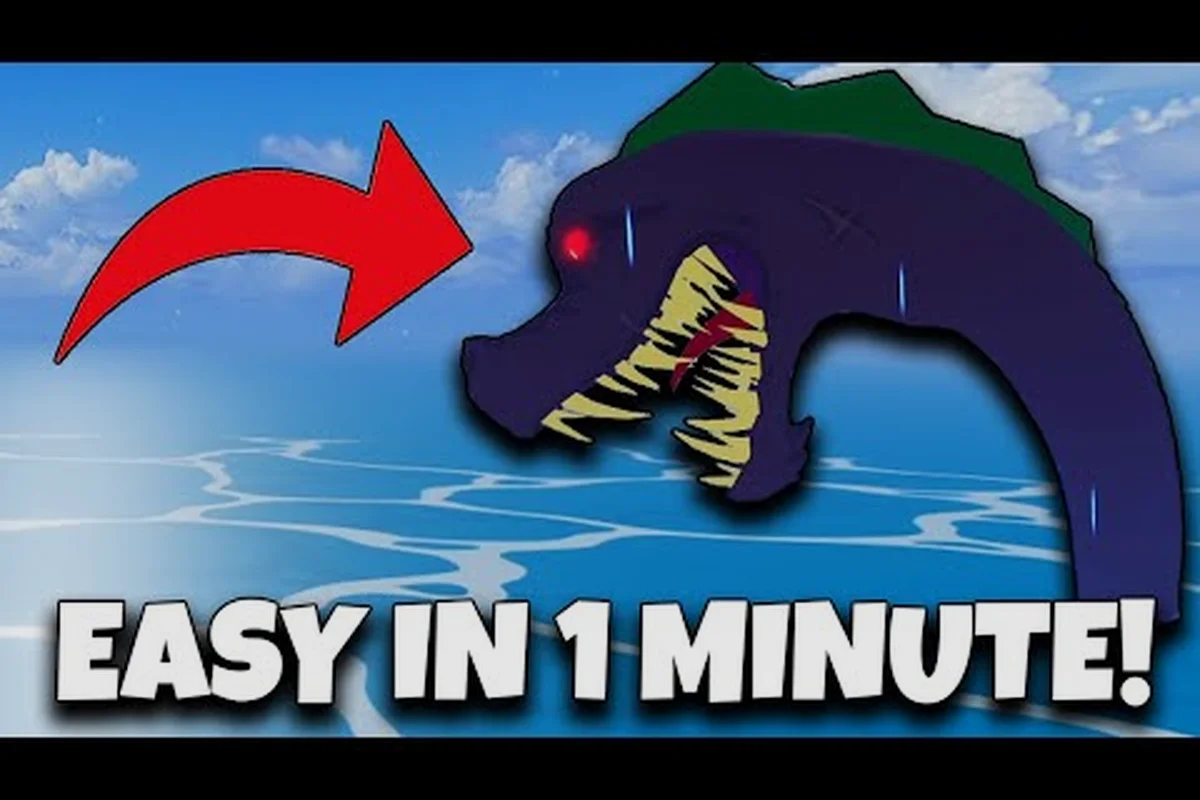
Sea beasts appear when you sail through open water, so a short route between islands can get you into a fight faster than waiting on land. The right sailing line, visual cues, and level preparation make Blox Fruits how to spawn sea beast searches much more efficient.
Blox Fruits How to Spawn Sea Beast: The Basic Spawn Rules
A sea beast is not summoned through a menu, quest, or fixed button press. It is an overworld encounter that can appear while you travel through eligible ocean waters, which means the core of Blox Fruits how to spawn sea beast involves navigation rather than waiting at a spawn point. Player reports and short community walkthroughs describe the same basic behavior: leave the dock, move into open water, and watch for a surface disturbance before the creature surfaces.
That distinction matters because some players search for a stationary spawn marker that does not exist. There is no reliable building button and no universal coordinate to farm. The sea beast appears because of an encounter roll while you are sailing, so the best route is one that maximizes uninterrupted time in open water while keeping you close enough to react when the warning appears.
The key mechanic is that sea beast encounters occur during sustained sailing in eligible ocean areas, so each trip across the Sea can provide another chance to trigger one. For example, a player can leave an island dock, sail through open water, and pause when a water disturbance appears; after the encounter resolves, continuing the route is more useful than returning to the dock or hunting for a fixed spawn location. Because the encounter is rolled rather than placed at a marked coordinate, exact respawn timers and spawn points should be treated as community estimates rather than confirmed fixed data. This is the practical foundation for Blox Fruits sea beast farming and differs from searching for a Blox Fruits boss timer or fixed boss spawn.
| Encounter detail | Practical meaning | What to do |
|---|---|---|
| Trigger area | Open ocean during sailing | Leave the dock and travel between islands |
| Warning sign | Visible disturbance in the water | Stop and face the sea beast immediately |
| Spawn method | Encounter-based, not menu-based | Keep moving instead of searching for a button |
| Respawn information | Community-tracked, not officially published | Treat exact timers as estimates |
| Main danger | High damage during travel | Bring healing and use ranged attacks |
How the water warning works
The water disturbance is the most useful early warning. A community video demonstrating the encounter describes it as a brief change on the ocean surface, and another player guide confirms that the sea beast can appear after a short sailing trip through the Second Sea. You should slow down when you notice the water ahead shifting or bubbling, then face the creature before it closes the distance.
Do not assume every dark patch is a sea beast. Waves, visual effects, and distant boats can look similar from a distance. Watch for a focused disturbance that remains in one area, especially while traveling through the open-water gaps between islands. If it fades before you approach, keep sailing rather than spending several minutes searching the same patch.
What “open water” really means
Open water is the space beyond the safe dock routes, not the exact center of the ocean. You do not need to sail to the edge of the map, and heading straight into distant empty water can leave you without nearby land for recovery. The most efficient path runs just far enough from the coast to qualify as ocean travel while preserving a short route back to an island.
This also explains why a direct offshore trip may not produce a spawn. Some player reports say that changing direction or moving around creates the encounter, but the exact trigger is not published as a fixed rule. Treat that behavior as a technique for creating more travel time rather than a guaranteed button or code.
The Fastest Open-Water Route for a Sea Beast Encounter
The quickest approach is a loop through a long shipping lane with open water on both sides. A straight line can expose you to a sea beast without giving you room to fight or escape, while a curved route lets you turn, circle, and pass another stretch of ocean without touching land. The one-minute sea beast walkthrough is a useful visual reference for this approach.
Start at an island dock in a sea appropriate to your character’s level, then sail a little beyond the normal coastal route. Maintain a steady cruise rather than stopping beside the island. If the water remains calm, continue until you spot a disturbance or complete the loop and try the adjacent gap.
A reliable sailing sequence
| Step | Action | Reason |
|---|---|---|
| 1 | Equip a boat and prepare healing | A sea beast can appear before the encounter is fully visible |
| 2 | Leave an island dock | The encounter requires travel through ocean water |
| 3 | Sail two to three island lengths offshore | This creates enough ocean exposure for a roll |
| 4 | Scan ahead for surface movement | The warning gives you a brief chance to prepare |
| 5 | Face the creature and attack | Acting quickly helps control the initial approach |
| 6 | Retreat toward an island if needed | Nearby land provides a recovery point |
The sequence is designed for consistency, not a guaranteed encounter on every lap. If no sea beast appears during a route, repeat the open-water leg with a slightly different angle. Community reports describe variable results, and no authoritative source publishes a guaranteed respawn timer for this encounter. As of 2026, exact timing should be treated as an estimate rather than a fixed mechanic.
Picking a Sea to Hunt In
Sea beasts are strongest opponents for unprepared characters, so route choice should depend on your level and combat style. The First Sea is easier, but a short route can produce a difficult fight for a new player. The Second Sea provides enough sailing space for the commonly shown method, while later seas may offer different travel conditions and stronger enemies.
Do not assume that a spawn in the First Sea gives the same rewards or difficulty as one in the Second Sea. A player can locate the creature in a low-level area and still struggle against its attacks. If you cannot survive the first exchange, farm the current island, improve your weapon, and bring enough healing before returning to the route.
The broader Blox Fruits boss guide explains how different encounters fit into progression and can help you choose a sea that matches your current strength. Because Sea Beasts change area and level as they travel, tracking one is different from farming a fixed boss spawn: check the creature’s current location, prepare for the route’s island mobs, and avoid mistaking an Elite Pirate for the Sea Beast. This matters when your goal is a specific drop, since chasing a target across seas can consume time without improving the odds of the encounter.
Sea Beast Spawn Preparation: Stats, Weapons, and Combat
Finding the water warning is only half the job. The best route is useless if the sea beast reaches your boat before your first attack lands. Preparation should improve your opening damage, survivability, and ability to control distance while avoiding the small window in which the warning is visible.
Build priorities for the encounter
| Preparation | Why it helps | Practical choice |
|---|---|---|
| Damage | Reduces the number of exchanges | Upgrade your current weapon before sailing |
| Burst | Helps punish the approach | Keep a ready ability or fruit skill |
| Healing | Restores health after a hit | Carry enough healing for several mistakes |
| Mobility | Creates space for attacks | Keep a dash or mobility fruit skill ready |
| Range | Reaches the target safely | Use a gun or ranged fruit when available |
A strong fruit is helpful, but it is not mandatory. A player with a reliable sword or gun can still win by maintaining range, attacking during recovery windows, and avoiding unnecessary damage. The goal is to make every attack count rather than relying on a single skill to delete the health bar.
The community sea beast demonstration shows the encounter as a combat rotation rather than a stationary boss arena. Watch how the player turns to face the target and shifts position during the fight. That movement matters because sailing creatures can move quickly, and facing the wrong direction may waste a strong ability.
Control the first attack
When the disturbance appears, turn toward it and begin attacking as soon as the sea beast becomes visible. If you have a ranged weapon, use the opening distance. If you have close-range melee, let the creature approach while keeping your boat pointed in the correct direction. Chasing it with attacks while facing another direction reduces your effective damage.
Do not rush into a full combo immediately. Use the first attack to confirm its behavior, then watch whether it lunges, circles, or attacks continuously. A combat pattern that changes after taking damage can make an otherwise easy encounter dangerous. Keep one movement option available so a missed combo does not leave you trapped.
Bring enough healing for a mistake
A full health bar is not the same as a safe encounter. Sea beast attacks can remove a large portion of health, and the danger increases if the target knocks your boat in an awkward direction. Bring healing for more than one mistake, especially if your weapon has low damage or your fruit has a long cooldown.
Players who treat the battle like a standard land boss often struggle because their positioning is less stable. Stay aware of the water, avoid drifting toward other enemies, and finish the encounter before collecting drops. If the fight becomes risky, sail toward an island after creating distance instead of remaining in open water with low health.
Blox Fruits Elite Pirate Locations for Safer Farming
Elite pirates offer another way to practice boss-style combat without relying on an unpredictable ocean encounter. They are land-based enemies tied to particular island areas, and community reports describe them as tougher than ordinary mobs with useful drops. This makes them a useful comparison for players studying elite pirate locations or preparing for the stronger Blox Fruits bosses.
Elite pirates versus sea beasts
| Factor | Sea beast | Elite pirate |
|---|---|---|
| Encounter type | Appears while sailing through open water | Located in specific island areas |
| Trigger | Moving encounter and visible water warning | Reaching the correct location |
| Reliability | Variable because no fixed public timer | More predictable when the location is known |
| Combat setting | Mobile water encounter | Land-based fight |
| Main value | Drops and a challenging ocean fight | Drops and elite combat practice |
| Preparation need | Healing and positioning at sea | Weapon upgrades and route knowledge |
Because elite pirates remain tied to their island, farming them follows the same level-band logic as normal enemy farming. Check your character’s current sea before assuming an old route is still appropriate. The boss list by area and level can provide a broader reference for deciding where your build belongs.
Finding an elite pirate efficiently
Search the island for signs of elevated enemy strength, such as a tougher-looking foe in a restricted area or a group positioned around a point of interest. Do not waste the entire search by fighting every normal enemy. Elite pirates are easier to identify when you already know which island and level range to examine, and their drops can make them worthwhile even when no sea beast appears during your sailing session.
Use the route to practice the same principles required for a sea beast: first isolate an elite pirate from nearby mobs, then create enough space to land your opening attack without being surrounded. For example, kite the elite pirate around a restricted area before using an AoE Fruit skill, and avoid pulling additional enemies into the fight. This preparation matters because elite pirates and Sea Beasts punish poor positioning, while a controlled engagement preserves Health, Energy, and Fruit stamina for the boss timer.
-
Approach control: Stop before committing to a dangerous area.
-
Opening burst: Begin with your strongest ready attack.
-
Position awareness: Keep an escape route behind you.
-
Resource timing: Save healing for moments when the enemy cannot be interrupted.
-
Target discipline: Focus the intended elite pirate rather than switching between nearby mobs.
A separate Three Sea bosses overview can help experienced players compare elite pirate farming with the more demanding named bosses found in later areas. For example, it can clarify why an elite pirate may offer a more repeatable bounty route than a Sea Beast encounter, while also highlighting the stronger enemy levels, larger boss timers, and greater punishment for poor positioning found in the Third Sea. Use that comparison to decide whether to keep farming the accessible elite pirate for steady rewards or commit to a named boss for its higher-value but riskier loot.
Blox Fruits Boss Timer, Bounty, and Spawn Estimates
Exact sea beast respawn data is not officially published, so the Blox Fruits boss timer should be treated as a community estimate rather than a guaranteed schedule. Many players simply repeat the sailing route until an encounter occurs. This makes route efficiency more valuable than waiting beside an unused spawn location.
What community timing information means
| Timing claim | Reliability | Best interpretation |
|---|---|---|
| A sea beast appears after a short sailing trip | Community reported | Useful as a route suggestion, not a guarantee |
| The encounter has a fixed respawn countdown | Not officially confirmed | Do not plan around one exact number |
| Changing direction can trigger an encounter | Player reported | Try it to extend time in open water |
| The disturbance appears before the creature | Repeatedly reported | Use it as the main early warning |
| Elite pirates respawn at a fixed location | Location based | Find the correct island area first |
The distinction between a spawn route and a respawn timer is essential. A route increases your chances because it creates travel conditions, while a timer describes when an existing world event becomes available again. In practice, community video explanations of the Blox Fruits boss timer focus on route rotations and visual cues because those are the parts players can control.
Why bounty changes your sailing priorities
Blox Fruits bounty comes from defeating players and certain enemies, and it also makes you a target for other players. Sailing alone through open water is therefore not always the safest way to test a route. If your character carries a bounty, the possibility of interception can outweigh the value of another sea beast attempt.
Community discussions treat bounty as a risk-management issue rather than a guarantee of extra rewards. Before entering a busy route, decide whether you have enough health, durability, and escape resources to handle both a sea beast and another player. If not, clear weaker enemies first or postpone the run until your loadout is more resilient.
| Situation | Better choice | Reason |
|---|---|---|
| No bounty and strong loadout | Sail the open-water route | The expected value is higher |
| Active bounty | Avoid crowded routes | Other players may interrupt the encounter |
| Weak weapon | Farm elite pirates on land | Their locations are more predictable |
| Low health or low durability | Stop and recover | One mistake can end the run |
| Repeated failed attempts | Change angle and loop | A new line creates more travel time |
Use the Blox Fruits bounty and boss resource guide to compare your current health, durability, and available escape options before committing to a Sea Beast route. For example, if you carry an active bounty but have a strong loadout, choose a less crowded sailing loop and save one emergency dash for player interceptors; if your weapon is weak, farming Elite Pirates on land can build resources without entering a contested Sea Beast spawn area. This balances expected Sea Beast progress against the added risk of losing the encounter—or your remaining health—to another player.
A Complete Sea Beast Farming Route
A reliable farm should combine preparation, uninterrupted sailing, quick reaction, and a clear recovery plan. The goal is not to chase a nonexistent button or memorize a single coordinate. It is to create repeated opportunities for the ocean encounter while keeping the run efficient enough to produce useful drops.
Before you sail
-
Upgrade your weapon: Higher damage shortens the fight and reduces the number of incoming hits.
-
Bring sufficient healing: Pack for several mistakes rather than one critical hit.
-
Select an appropriate sea: Match the route to your level and current progression.
-
Check your bounty: Avoid vulnerable routes while another player can interrupt you.
-
Choose the right route length: Sail enough to trigger travel, but not so far that landing becomes difficult.
While you travel
-
Leave the dock promptly: The encounter depends on time spent in ocean waters.
-
Keep a steady course: Long uninterrupted movement improves your odds.
-
Scan the surface: Look for a localized disturbance ahead of the boat.
-
Turn when needed: A slight course change can create more eligible travel time.
-
Avoid stopping: Do not idle beside the same patch of ocean waiting for a spawn.
During combat
-
Face the creature: Keep your character and camera aligned with the target.
-
Use burst damage: Start with your strongest available opening attack.
-
Maintain distance: Ranged attacks work best when the target approaches.
-
Watch the attack pattern: Do not continue a combo if the creature changes behavior.
-
Retreat when necessary: Move toward land if health drops and the fight no longer looks winnable.
Post-Battle Recovery and Positioning
Collect drops immediately, repair or replace equipment before the next route, and decide whether another sea beast attempt fits your session. If several attempts produce no encounter, switch to elite pirates or another boss. Changing activities is more productive than repeating the same unsuccessful line indefinitely, and it still builds experience with Blox Fruits bosses.
Frequently Asked Questions
Can you directly spawn a sea beast in Blox Fruits?
No direct button or quest summons a sea beast. It appears as a moving encounter while you sail through open water, usually after a visible water disturbance. The most effective method is to leave an island, travel through a long ocean route, and repeat different lines when needed, while community timing data remains approximate rather than a fixed public spawn schedule.
Which sea is the easiest for finding a sea beast?
The First Sea is generally the more accessible choice for a weaker character, although a short route can still create a difficult encounter. The Second Sea is commonly used in visual guides because players have room to travel and fight. Choose a sea that matches your level, upgrade your weapon, and bring enough healing before starting a farming route.
Where are elite pirate locations in Blox Fruits?
Elite pirates are found in specific island areas rather than randomly appearing while you sail. Their locations are tied to islands and level bands, so an old route may no longer be appropriate after you advance. Research the correct island for your current sea, then use the visual differences between elite enemies and ordinary mobs to locate them efficiently.
Is there an exact Blox Fruits boss timer for sea beasts?
No authoritative fixed respawn timer is published, and exact claims should be treated as estimates based on community observations. Because sea beasts are encountered while traveling through open water, the practical solution is to repeat an efficient sailing route rather than waiting beside a fixed coordinate. The visible water warning remains the clearest signal that an encounter is starting.
Should you farm sea beasts while carrying Blox Fruits bounty?
Carrying bounty adds risk because other players can interrupt your farming run. Sail only with a strong loadout, plenty of healing, and a safe escape plan. If your character is weak or already targeted, farming a predictable elite pirate location or preparing your gear can produce a safer session than repeatedly entering open water for another encounter.