
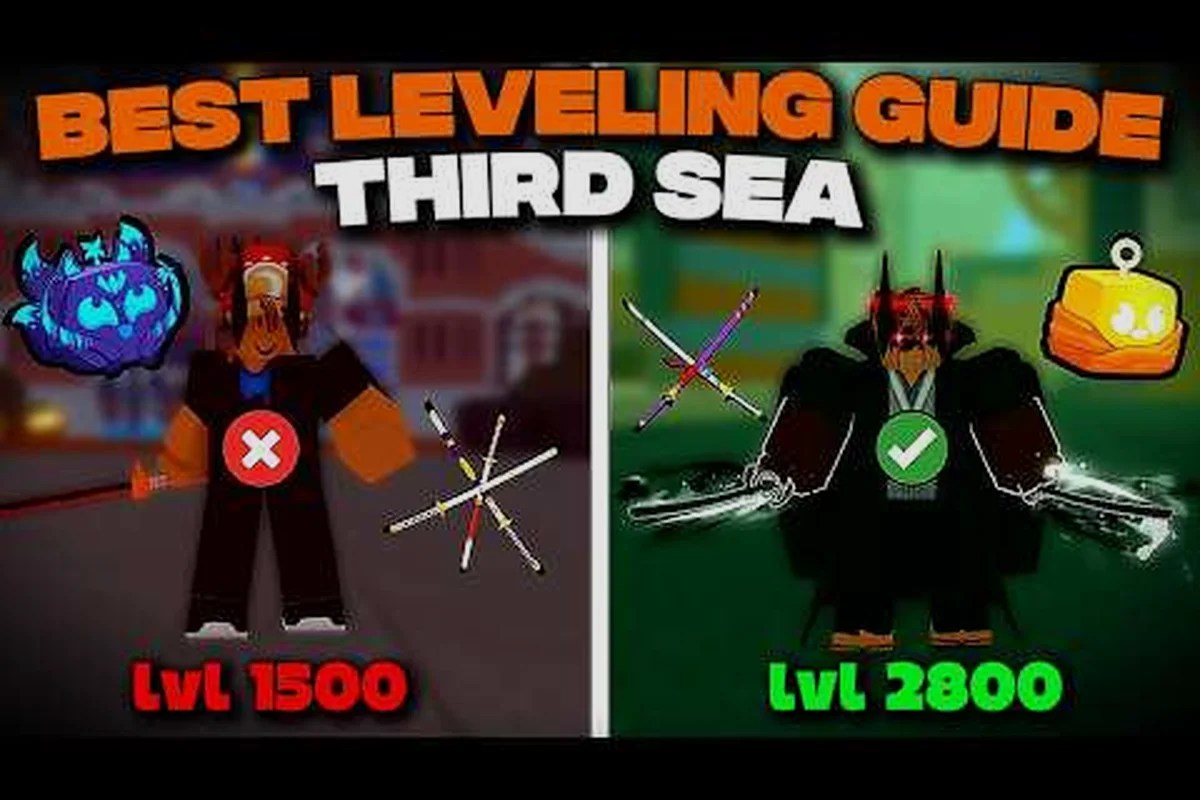
Blox Fruits third sea leveling matters because the route from 1,500 to 3,000 combines tougher enemies with better quest rewards and bosses. Learn the island order, farming loops, and money routine that turn each reset into steady progress.
Grinding the Third Sea from 1500 Upward
Blox Fruits third sea leveling begins at Port Town and continues through Hydra Island, Great Tree, Floating Turtle, Haunted Castle, Sea of Treats, Tiki Outpost, and Submerged Island. The important rule is to move only when the current island stops providing efficient experience. That approach keeps travel time and defeat downtime from undermining every kill.
The 1500 to 3000 progression band is not designed for one fixed island. It contains several distinct farming stages, each with stronger mobs, better quest payouts, and more demanding combat. A practical route uses normal enemies for experience, story missions for larger XP chunks, and bosses for both experience and Beli.
| Progression stage | Main farming area | Player priority | Recommended move point |
|---|---|---|---|
| 1,500–1,800 | Port Town and nearby areas | Learn the local rotation | Move when mobs take too long |
| 1,800–2,100 | Hydra Island and Great Tree | Improve kill speed | Continue until rotations slow |
| 2,100–2,400 | Floating Turtle and Haunted Castle | Add quests and bosses | Avoid long travel chains |
| 2,400–2,700 | Sea of Treats and Tiki Outpost | Balance XP with Beli | Upgrade gear before slowing |
| 2,700–3,000 | Submerged Island | Finish with boss loops | Use quests between boss runs |
The Repeatable Third Sea Loop
A reliable XP-first rotation begins near a quest giver, accepts the available quest, defeats the required enemies, turns in the mission, and repeats. Once the quest chain advances, the player can return to local mobs for faster kills. This approach matters because quest XP can accelerate the early part of each island, while mob XP becomes more valuable when every kill is quick.
When to advance
Move to the next island only when your current level, quest progress, and combat performance all support the jump: you have reached the target range for that area, cleared the required story milestones, and can defeat its mobs without relying on extra time or repeated healing. For example, in the Blox Fruits 700 to 1500 and Blox Fruits 1500 to 3000 stages, advancing too early can slow quest completion because enemy levels are still far above your character, while waiting after clearing the area wastes valuable EXP and money farming opportunities.
-
Your current rotation requires repeated long walks between enemies.
-
Normal mobs take long enough to interrupt the farming rhythm.
-
Your build or equipment is preventing fast quest completion.
Player reports commonly describe the highest island you can clear in one smooth rotation as the Blox Fruits best grinding island for your current range. That does not mean you must move the instant one mob survives longer. A short struggle can still be worth it if the new area delivers significantly better XP per kill.
Blox Fruits 1500 to 3000 Island Progression
The Blox Fruits 1500 to 3000 stretch works best when each destination has a specific purpose. Port Town and Hydra Island establish the third-sea rhythm, Great Tree improves quest efficiency, Floating Turtle and Haunted Castle introduce stronger routines, and Sea of Treats through Submerged Island provide late-stage rewards. Moving gradually prevents combat difficulty from rising faster than your build.
Island-by-island farming plan
| Island | Useful activities | Main reward | Common slowdown |
|---|---|---|---|
| Port Town | Local mobs and available quests | Early third-sea XP | Weak early build |
| Hydra Island | Quest chains and efficient local groups | Quest XP | Wandering between camps |
| Great Tree | Story progression and mob rotations | Mixed XP and boss access | Long central distances |
| Floating Turtle | Mobs, chests, and boss farming | XP plus Beli | Boss reload time |
| Haunted Castle | Quests and castle boss routes | Strong quest payouts | Difficult enemies |
| Sea of Treats | Group kills and repeat encounters | Improved XP rate | Uneven mob clusters |
| Tiki Outpost | High-tier mobs and boss runs | Strong XP and Beli | Gear checks |
| Submerged Island | Late third-sea quests and bosses | Route to level 3,000 | Boss-oriented combat |
Port Town to Great Tree
Port Town is valuable because it gives new third-sea players a manageable transition rather than an instant difficulty spike. Complete the available quest line, farm the closest group of normal enemies, and avoid wandering between distant camps. The goal is not to spend hours at the starting point; it is to establish a quick rotation before difficulty increases.
Hydra Island and Great Tree form the first major checkpoint. Their quest rewards give meaningful progress, but the best results come from combining them with nearby mob farming. A clear loop is to claim the next quest, defeat its targets, complete the mission, then grind one nearby group before beginning another quest chain. If your Blox Fruits grinding guide route separates quests and grinding too much, travel time can erase the theoretical reward.
Floating Turtle through Tiki Outpost
Floating Turtle, Haunted Castle, Sea of Treats, and Tiki Outpost reward players who can defeat enemies consistently. Story missions become more attractive here because their XP totals can exceed many ordinary kills. At the same time, the Blox Fruits how to grind routine should remain simple: fight close groups, collect Beli and drops, and avoid long cross-map runs.
Bosses add value when their cooldown fits the route. Fighting a boss for one level while spending several minutes traveling may be worse than completing two shorter quest cycles. Compare the boss reward with the time required for a comparable sequence of mobs, then keep the option that produces more useful progress per minute.
Submerged Island and the level 3,000 finish
Submerged Island serves as the final third-sea destination before the 3,000 threshold. Its quest chain and enemies are more demanding, so the Best Third Sea Leveling Guide illustrates a progression approach rather than suggesting that every player should camp there from level 1,500.
Before finishing the Blox Fruits 700 to 1500 transition into this range, bring a reliable build with enough damage, mobility, and stamina. The exact numbers change with game updates, but the test is practical: defeat a standard enemy without extended positioning, and complete a boss attempt without losing most of the fight.
Blox Fruits Grinding Guide for Faster Third-Sea Experience
Efficient grinding depends on kills per minute, not simply on the size of the XP number displayed after a defeat. The best route minimizes travel, uses easy targets, and finishes rewards without unnecessary menu or inventory management. This is why a slightly weaker island can outperform a harder one when its mobs are grouped closely and your quests are already available.
Build and equipment checks
Before changing islands, test the current rotation under realistic conditions. A useful Fast Rotation Test consists of five normal kills and one quest objective. If positioning or recovery regularly interrupts the sequence, improve your setup before making a longer route.
| Build element | Why it matters | Practical upgrade trigger |
|---|---|---|
| Weapon damage | Shortens time-to-kill | Mobs survive multiple normal hits |
| Stamina | Supports dodges and movement | Frequent stamina stalls |
| Health or defense | Prevents defeat resets | Enemies remove a large health share |
| Fruit or combat mastery | Improves overall damage output | Damage feels weak against bosses |
| Quest equipment | Speeds up task objectives | Quest mobs take too long |
Two Separate Goals: XP and Beli
Do not expect the best experience route and the best Beli route to be identical. Normal mobs usually offer a cleaner experience loop, while bosses and chests can produce valuable currency. Blox Fruits money farming should therefore run as a parallel objective rather than replacing every combat rotation.
A balanced routine should pair fast, repeatable mob encounters with higher-risk activities that reward Beli, chest drops, and quest progress. For example, use a Blox Fruits best grinding island with a dense enemy spawn to cover the 700 to 1500 level range, then shift toward bosses and sea events once you approach 1500 to 3000. Keep combat builds functional rather than spending every material on damage; Health and Energy investments reduce death time, while the Blox Fruits how to grind approach remains centered on preserving momentum and clearing waves efficiently.
-
Complete two or three quest objectives.
-
Farm a nearby group for stable XP.
-
Defeat one worthwhile boss for XP, Beli, and drops.
-
Collect nearby chests when they are already on the path.
-
Repeat the route while checking quest progress.
Reduce avoidable downtime
Stand near the center of the next mob group before engaging. Face the nearest target first so weaker enemies do not attack from behind, and use area attacks when several targets are clustered. Avoid collecting drops manually after every kill; select the relevant items and use the inventory less often.
| Grinding habit | Time impact | Better approach |
|---|---|---|
| Running between scattered mobs | High | Rotate among nearby clusters |
| Checking inventory after every kill | Medium | Batch item management |
| Ignoring available quests | High | Alternate quests and local farming |
| Fighting bosses from maximum range | Medium | Learn boss attack patterns |
| Moving ahead without a build check | Variable | Test the next island briefly |
Community videos such as this third-sea leveling walkthrough support the same core principle reported by players: use the highest area you can clear without excessive downtime. The advice is practical rather than universal because enemy density, quest availability, and player strength differ across the route.
Blox Fruits Best Grinding Island and Efficient Quest Loops
The Blox Fruits best grinding island is the highest island that supports a clean, repeatable cycle for your current build. It may be Hydra Island for a player who cannot yet defeat Great Tree enemies, or Sea of Treats for a stronger account that has outgrown Tiki Outpost. An island becomes inefficient only when travel, defeat time, or quest difficulty outweighs the better rewards.
Evaluate an island with a five-minute test
Use the first five minutes on a new island to measure performance rather than making an emotional decision based on its rewards. During a Third Sea test, track how quickly you complete the current quest, whether mobs survive long enough to reduce your Health, and how much Mastery XP you gain from each group. For example, if you clear several camps without repeatedly repositioning and reach a noticeable level gain, the island’s spawn density and quest pacing suit your current build; weak results across those checks usually mean the route is inefficient even if its drop rates look attractive.
| Test measure | Strong result | Weak result |
|---|---|---|
| Kills completed | Many without interruption | Frequent repositioning |
| Quest objective speed | Completed before health pressure builds | Enemy survives too long |
| Travel between groups | Short and predictable | Long or confusing |
| Boss attempt | Survives most of the fight | Loses early |
| Level progress | Noticeable XP gain | Little progress after several fights |
If most results are weak, stay on the previous island and improve your setup. If only the boss test is weak, continue normal grinding and return to that boss after better gear or mastery upgrades. This prevents one difficult encounter from disrupting the entire experience route.
Quest chain optimization
Quests are especially useful early in each new island because they provide larger experience rewards than basic kills. Accept the next mission immediately, gather several targets at once when possible, and complete the chain before repeating it. Once the quest progression slows or sends you across the map, return to a dense mob area.
Quest-and-mob pairing creates a reliable sequence because quest XP and basic-kill XP fill different parts of each third-sea level cycle. For example, pair a mission that sends you toward a nearby enemy group with a local spawn rotation at that destination, then return to the quest giver only after the objective is complete. This avoids wasting travel time on a second unrelated route and helps you maintain momentum while progressing through the Blox Fruits 1500 to 3000 range.
-
Finish a quest objective and claim its reward.
-
Use the next mission as a travel objective rather than an extra separate trip.
-
Complete one local mob rotation.
-
Claim the next quest and repeat.
The broader Blox Fruits leveling guide can help players connect first- and second-sea preparation to the third sea. For this stage, the key transition is already completed: the third sea begins after the Blox Fruits 700 to 1500 range, so focus on the islands and quests designed for the current difficulty tier.
Mix bosses without losing the main loop
Bosses are worth including when their travel time is acceptable. Their reward value includes experience, Beli, and potential drops, so they can serve several progression goals at once. However, repeated retries against an unprepared boss often reduce efficiency more than they improve it.
During Blox Fruits Third Sea leveling, treat bosses as optional progression checks rather than mandatory destinations. For example, a boss that sits along a route toward an XP farming island can provide worthwhile EXP, Beli, and a possible drop without adding much travel, while a remote Sea Event boss may consume too much time for the same reward. This is especially relevant when moving from level 700 to 1500 or 1500 to 3000, where preserving quest and mob-farming efficiency can produce steadier progress than repeatedly fighting an unprepared target.
-
Check the boss’s approximate level relative to yours.
-
Compare the expected fight length with your normal quest cycle.
-
Attempt it once when the route is nearby.
-
Return to mobs or quests if the attempt ends quickly.
-
Revisit after a meaningful power or build improvement.
This method makes boss farming flexible because you can judge each encounter by its actual time cost rather than committing to every spawn. For example, during Blox Fruits Third Sea leveling, clear a boss located near your preferred XP farming island if its level is manageable, then return to mob quests; skip a difficult Sea Event boss when its expected fight duration and travel time outweigh the potential EXP, Beli, and drop rewards. A useful threshold is one quick attempt: if the target does not finish within a few minutes, disengage and preserve your main grinding loop.
Blox Fruits Money Farming and Boss Routes for Level 3,000
Beli funding is essential because stronger third-sea gear can improve kill speed, reduce deaths, and make the final stretch of the Blox Fruits 1500 to 3000 route much smoother. A good money routine uses enemies and chests that already sit near the leveling path. Separate travel routes consume time and make both objectives slower.
Priority money activities
| Activity | Beli efficiency | Leveling value | Best use |
|---|---|---|---|
| Normal third-sea mobs | Moderate | High | Main leveling rotation |
| Story bosses | High | Medium to high | Quest-adjacent farming |
| World bosses | Variable | Medium | Group events and bonus runs |
| Chests | Moderate | Low | Collect during normal travel |
| Repeatable NPCs | Moderate | Low | Fill gaps between combat |
Begin with quest-adjacent bosses because they serve the experience route as well as the income route. Complete an available story mission, defeat the associated boss when possible, collect the reward, and then return to a nearby group. This prevents a long dedicated money route from displacing the primary XP loop.
Build a practical Beli routine
A repeatable routine can include two boss attempts, one chest sweep, and one mob rotation. The exact order should follow the map rather than forcing unnecessary travel. If a boss sits near the path to a quest area, fight it first; if a reward island is already nearby, collect chests while moving between targets.
For broader farming methods, the Blox Fruits farming guide explains how income and progression can support one another. The key third-sea principle is to use Beli on a specific bottleneck: weak damage, insufficient stamina, or poor survivability. Spending randomly across unrelated systems can leave every part of the build underpowered.
When Beli income should come first
Stop and improve the build when enemies consistently consume too much health, your attacks miss important windows, or a boss ends the attempt before the main damage phase. These are efficiency problems, not reasons to force a harder island. A short investment in the correct upgrade usually returns more value than several unproductive grinding sessions.
| Symptom | Likely bottleneck | Priority response |
|---|---|---|
| Damage is too low | Weapon or mastery | Improve damage output |
| Dodging ends the fight | Stamina and mobility | Improve stamina management |
| Bosses heal faster than expected | Burst damage | Add stronger attacks |
| You die to grouped enemies | Area control and defense | Improve survival tools |
| Progress feels slow despite kills | Travel and quest planning | Shorten the rotation |
Third-Sea Leveling Checklist Before Moving Up
Use a short checklist after every major island transition to verify that the move is worthwhile. Compare chest spawns, enemy density, quest availability, and money earned per session before committing to the next island; for example, test whether the new route supports the Blox Fruits 700 to 1500 progression more efficiently than the previous zone. This prevents weak results from being hidden by simply grinding longer, while showing which stat increase or boss unlock justifies the transition toward 1500 to 3000 mastery.
Equipment and quest check
-
Confirm that your current weapon can defeat standard enemies efficiently.
-
Check the next story quest before committing to another long mob session.
-
Collect completed quest rewards instead of leaving them in the quest menu.
-
Compare your Beli balance with the next meaningful equipment upgrade.
-
Test one boss after improving damage or survivability.
Rotation check
-
Track how long one full mob rotation takes.
-
Identify the slowest step: travel, positioning, attack time, or item management.
-
Reduce unnecessary distance before changing islands.
-
Move only when normal mobs and quests both provide slower progress than the next destination.
-
Keep one lower-tier island available for temporary farming or boss attempts.
The third-sea islands overview is useful when checking destinations and access requirements. Once the route is unlocked, the decision should depend on combat efficiency and rewards rather than on reaching an island as early as possible.
Final progression test
You are ready to focus on level 3,000 when you can defeat the next island’s standard enemies, clear its quest objectives, and make progress in a short farming session. If only one activity fails, adjust that activity specifically instead of reversing the entire route.
| Readiness area | Ready indicator | Needed correction |
|---|---|---|
| Normal combat | Several quick kills without danger | Improve damage or stamina |
| Quests | Objectives complete before reset | Strengthen the build |
| Bosses | Most of the fight is sustainable | Upgrade survival or burst |
| Economy | Enough Beli for the next upgrade | Run an income loop |
| Navigation | Rotation has little wasted travel | Reorder targets |
Frequently Asked Questions
What is the fastest way to level from 1,500 to 3,000 in Blox Fruits?
The fastest practical route alternates quests, nearby mob farming, and worthwhile bosses. Start around Port Town and Hydra Island, then progress through Great Tree, Floating Turtle, Haunted Castle, Sea of Treats, Tiki Outpost, and Submerged Island. Move forward only when the current area no longer supports quick kills and efficient quest turns.
Which island is best for third-sea grinding?
The best island is the highest one you can clear in one smooth rotation. Early players often farm around Port Town, Hydra Island, or Great Tree, while stronger accounts use Sea of Treats, Tiki Outpost, and Submerged Island. Compare actual kills per minute instead of relying only on the island’s higher level.
Should I keep completing quests while grinding?
Yes, especially after reaching a new island. Quests often provide larger experience rewards and can guide you toward efficient groups of enemies. Alternate quest objectives with local mob farming instead of repeating one quest endlessly. Once quests become slow or spread across the map, prioritize nearby enemies until the next mission becomes available.
How do I earn enough Beli during third-sea leveling?
Farm normal mobs for steady Beli, defeat bosses that already sit near quest routes, and collect chests during normal travel. A balanced session can include two boss attempts, one chest sweep, and several mob rotations. Spend the income on the equipment or mastery bottleneck that is reducing your kill speed.
Is it better to move to the next island or upgrade first?
Move when the next island offers clearly better quest rewards and you can defeat its standard enemies without repeated resets. Upgrade first when damage, stamina, or survivability causes slow kills. A short gear improvement often raises XP per minute more than changing to a harder location with the same weak build.