
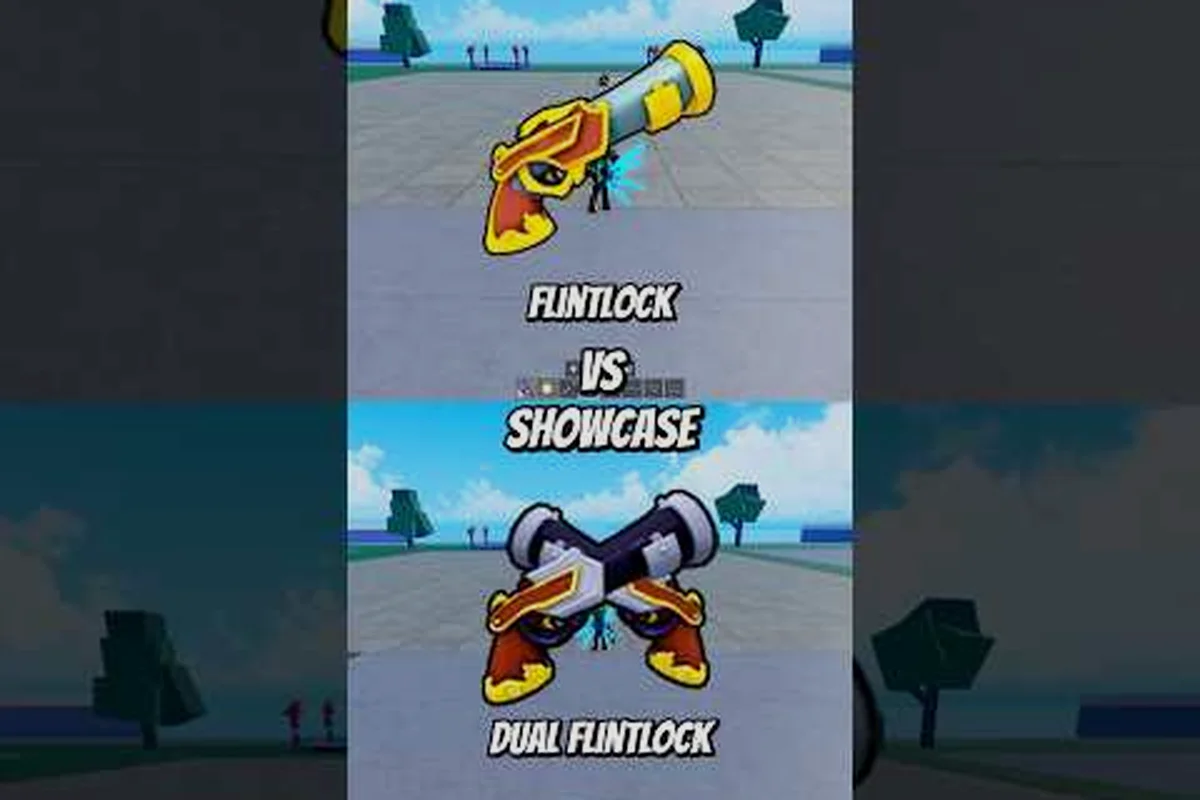
The Blox Fruits Flintlock matters because it gives ranged players a fast, reloadable way to pressure targets while a separate melee setup handles close-range combos. Learn how its stats and mastery compare with the Musket, Kabucha, and other gear so you can build a practical setup for PvP, bosses, and quests.
Blox Fruits Flintlock Stats and Core Performance
The Blox Fruits Flintlock is a mid-tier firearm that occupies a useful space between the basic Slingshot and later gun upgrades such as the Dual Flintlock and Magma Blaster. Community comparisons describe the Flintlock as a middle-ground weapon whose main advantages are speed, reach, and reload behavior rather than an enormous raw-damage jump. That makes it especially useful when you want ranged pressure without giving up the ability to fight at close range.
Its practical identity is easier to understand when you separate Ranged Damage, Aim, and Reload Speed. Damage determines how quickly a shot contributes to a target’s health pool, aim affects consistency, and reload speed controls how often you can threaten an opponent during a short exchange. A weapon can feel strong in one area without dominating every situation, so the best setup depends on whether you value quick attacks, mobility, or raw burst damage.
| Flintlock attribute | Practical effect | Best use |
|---|---|---|
| Ranged damage | Moderate contribution per hit | General quest damage and pressure after a stun |
| Aim | Reliable target acquisition | Beginner-friendly ranged attacks |
| Reload speed | Short interruptions between volleys | Quick PvP pressure and repeated repositioning |
| Effective range | Useful beyond melee distance | Finishing retreating or stunned enemies |
| Weapon class | Single ranged firearm slot | Pairing with a fruit, sword, or fighting style |
How the Flintlock compares with the Musket
The Blox Fruits Musket occupies the same broad gun category, but it should be evaluated as a different practical tool rather than as a simple upgrade. The Musket generally emphasizes heavier ranged punishment, while the Flintlock favors faster cycling and a less demanding rhythm. If you need to pressure a target between movement animations, the Flintlock often feels more natural; if you can land one decisive ranged hit, the Musket may offer greater impact.
| Comparison point | Blox Fruits Flintlock | Blox Fruits Musket |
|---|---|---|
| Attack rhythm | Faster repeated attacks | Slower, heavier attacks |
| Best attribute | Reload speed and handling | Ranged damage |
| Target profile | Moving or frequently repositioning opponents | Stunned targets or safer firing lanes |
| Setup role | Flexible sidearm | Deliberate burst weapon |
| Skill ceiling | Accessible timing | Requires better shot placement |
A community gun comparison presented in Flintlock vs Dual Flintlock characterizes the Flintlock and Musket as mid-tier options between the Slingshot and higher-rarity firearms. It also notes that accessories mainly come from bosses and complete a gun-focused equipment setup. That matters because the weapon itself does not need to carry every stat requirement alone.
Damage in real combat
Raw damage should not be treated as the only measure of weapon strength. A ranged hit that lands during an enemy’s recovery window can be worth more than a larger hit forced at an awkward angle. The Flintlock rewards players who can create a firing lane, use it after a melee stun, or chase an opponent as their health falls.
For normal quests, the weapon is dependable because its attacks are simple and its speed allows repeated pressure. During harder boss fights, however, positioning becomes more important. Bosses may move around the arena, change attack patterns, or close the distance rapidly. In those moments, a melee option prevents the gun user from becoming trapped in an awkward firing position.
Blox Fruits Flintlock Mastery and Progression
Mastery improves the weapon through targeted upgrades rather than simply making every stat rise at once. Players should therefore learn which mastery stage changes the attribute they actually use. If your priority is consistent damage, follow the damage path; if missed shots and awkward reloads cause frustration, focus on aim and handling before adding more offensive pressure.
Mastery upgrade priorities
| Player problem | Mastery priority | Result in combat |
|---|---|---|
| Shots often miss | Aim | More dependable attacks against moving enemies |
| Damage window is too short | Ranged damage | Faster progress against bosses and quests |
| Frequent reloads interrupt pressure | Reload speed | Better continuity during short PvP windows |
| Mixed goals | Damage and reload balance | Flexible general-purpose setup |
The most important progression rule is to test upgrades with the equipment you expect to use. A weapon that performs well with a particular fruit may feel slower if you are constantly switching to a melee combo. For broader mastery guidance, the Blox Fruits gun mastery overview explains why weapon stats, accessories, and mastery choices should be evaluated together.
Choosing Damage Before Utility
Damage-first mastery makes sense when you already have reliable aim and rarely need to fire more than once during an encounter. It is particularly useful against bosses whose movement is predictable, or during quests where you can maintain a safe distance. The advantage is straightforward: each successful shot removes more health, reducing the number of attacks required to finish a target.
Upgrade damage only when Hit Confirmation is consistent. If a large percentage of shots miss because an enemy changes direction or the camera angle is wrong, more damage will not solve the core problem. Practice against a basic enemy in a clear area, watch where the projectile travels, and make small camera adjustments before firing. Consistent geometry often creates more value than an unmeasured stat increase.
When to prioritize aim and reload speed
Aim and reload speed deserve earlier attention in PvP. Even a small change in consistency can create a meaningful advantage because PvP exchanges are usually short. A reload improvement helps you threaten an opponent again before they recover, while better aim reduces wasted pressure and makes it safer to use the gun around obstacles.
A practical test is to record how many attacks you can land during a fixed sequence, such as one dodge, one ranged shot, and one reposition. Do not count damage; count usable attacks. If your score is inconsistent, improve the weakest part of that loop. The Blox Fruits inventory guide can help organize equipped guns, melee gear, and stored accessories while you compare upgrades.
Avoid wasteful mastery spreading
Spreading mastery across several guns can make every weapon feel underdeveloped. If the Flintlock is your main firearm, concentrate its mastery until it reaches a stable performance level, then decide whether to maintain a second gun for a specific role. A clear main weapon and a situational backup are easier to manage than three partially upgraded options.
Keep spare guns only when they serve distinct purposes. For example, one firearm may suit close-range PvP, while another offers longer-range pressure against bosses. Otherwise, focus on one firearm and direct spare access toward the best melee weapon and a useful accessory.
Blox Fruits Flintlock Combos with Melee and Accessories
A strong gun setup does not need to replace a melee build. The most effective arrangement gives each slot a clear responsibility: the fruit or melee weapon opens opportunities, the Flintlock confirms damage, and the accessory corrects a stat gap. This structure is more reliable than expecting the firearm to handle every phase of combat.
Superhuman as the close-range opener
Blox Fruits Superhuman serves as a melee style rather than a firearm upgrade, making it a practical companion for players who want their gun to handle only part of an encounter. It can provide the gap-closing pressure or stun window that allows the Flintlock to fire safely. Community analysis in this Superhuman gameplay reference supports using melee as a separate role within a gun-focused setup.
| Equipment slot | Main responsibility | Combat behavior |
|---|---|---|
| Melee or fruit | Open the target | Use first when an opening appears |
| Flintlock | Confirm damage and chase | Fire after the opening is created |
| Accessory | Cover a stat weakness | Support speed, health, or damage goals |
Superhuman is especially useful when the target is too close for comfortable gun attacks. Rather than firing continuously at a point-blank opponent, you can use the melee style to create space or interrupt the enemy, then switch to the Flintlock. That division keeps the weapon relevant without forcing an awkward full combo from every range.
Choosing Blox Fruits melee for PvP
Blox Fruits melee should be chosen for the role the gun cannot perform. A fast melee style with strong stun potential is valuable for creating gun openings, while a heavier sword may deliver more damage if your build already has enough speed to fire reliably afterward. The correct choice depends on your level, the target, and whether you prefer mobile play or stronger close-range damage.
Do not select melee only because it has a higher listed damage value. Stun duration, energy use, attack reach, and the time required to recover matter more when a firearm is part of the rotation. A weaker opener that consistently creates a safe shot can outperform a stronger opener that leaves you vulnerable.
Selecting Blox Fruits accessories
Blox Fruits accessories complete the remaining equipment slot and are primarily obtained from bosses. Their value comes from filling a build weakness rather than stacking a single stat without consideration. A build that fires accurately but is eliminated by one strong hit may need health, while a mobile build may benefit more from speed.
| Accessory priority | Best-supported build | Reason |
|---|---|---|
| Health | Players taking heavy boss damage | Survives mistakes and trades more safely |
| Speed | Close-range and mobile PvP | Creates space before the Flintlock attack |
| Damage | Accurate players with stable timing | Turns confirmed hits into faster clears |
| Energy | Aggressive melee-and-gun rotations | Supports repeated ability use |
Accessory choice also changes with the weapon. The Flintlock benefits from attack speed because it improves the overall rhythm of the rotation, but it should not make the player so fragile that the gun becomes unusable. Community experience commonly supports balanced accessory choices, although exact results can vary by account level and enemy.
Blox Fruits Flintlock PvP, Quest, and Boss Strategy
The Flintlock performs best when the player uses it in a deliberate sequence. Random firing rarely creates pressure, especially against opponents who can recover quickly. Instead, identify a melee opener, create distance, land the gun shot, and then reset. This method works in PvP and adapts to bosses with different movement patterns.
A reliable PvP rotation
Start with the strongest melee or fruit technique available when the opponent is within range. After the stun lands, use the Flintlock to confirm damage while the target cannot respond. If the opponent escapes, maintain distance and chase with ranged attacks. If the opponent closes again, return to the opener rather than wasting shots in a point-blank exchange.
| Combat phase | Action | Purpose |
|---|---|---|
| Approach | Use melee or fruit to close safely | Create a controlled engagement |
| Opening | Land the primary stun or combo | Briefly remove enemy control |
| Confirmation | Fire the Flintlock | Convert the opening into damage |
| Chase | Reposition and fire while retreating | Punish escapes without overextending |
| Reset | Repeat from safe range | Maintain a consistent rhythm |
The Flintlock is generally better as a Confirmation Weapon than a Combo Starter. Community PvP guidance reports that guns are most effective for confirming damage after a stun or punishing an escape, while a sword or fruit can deal more damage when used as the primary combo source.
Quest use and energy management
During quests, the main objective is consistency. Use the gun whenever it saves travel time or reduces the number of attacks needed, but switch to melee when enemies reach you. This reduces wasted shots and avoids losing health through an otherwise unnecessary duel. It also makes the weapon more valuable for players who rotate between multiple islands rather than fighting in one familiar area.
Energy management is equally important. A firearm may not consume melee energy, but excessive switching, fruit use, and accessory-dependent attacks can still leave a player without resources. Save powerful abilities for bosses or dangerous enemies, then use the Flintlock for routine damage when its speed is the deciding factor.
Boss encounters and positioning
Boss fights test whether the player can use ranged attacks without blocking their own escape route. Before firing, identify the boss’s safe side and maintain enough space to see the entire arena. After each shot, move again rather than standing beside the target. This is particularly important against bosses with sweeping attacks or sudden movement changes.
| Boss behavior | Best response |
|---|---|
| Slow, predictable movement | Fire after melee and maintain mid-range pressure |
| Frequent repositioning | Short bursts followed by immediate repositioning |
| Rapid gap closing | Use melee to control space and gun only after the opening |
| Long attack animations | Use the full Flintlock interval, then reset distance |
Boss accessories can make the gun setup more sustainable, but they should not encourage reckless spacing. A small health increase can reduce the cost of one mistake, yet it cannot rescue a player who fights directly inside an enemy’s strongest attack. The Blox Fruits boss drop guide can help you understand where accessory-focused gear fits into boss preparation.
Blox Fruits Flintlock vs Kabucha and Other Gun Options
Comparing the Flintlock with the Blox Fruits Kabucha helps clarify whether the older firearm is still worth using. The Kabucha belongs to a later gun tier and introduces different utility, while the Flintlock focuses on straightforward, responsive attacks. An upgrade is valuable only when it solves a problem your current setup actually has.
Flintlock and Kabucha compared
| Category | Blox Fruits Flintlock | Blox Fruits Kabucha |
|---|---|---|
| Progression tier | Mid-tier firearm | Later firearm option |
| Core identity | Fast, familiar ranged pressure | Higher-tier gun utility |
| Learning requirement | Low | Moderate |
| Best use | General ranged support and PvP confirmation | Players who need stronger late-game gun options |
| Upgrade priority | Improve only if your build is underpowered | Consider when the current gun cannot contribute meaningfully |
The Blox Fruits Kabucha can be more attractive for a player who has already mastered a basic firearm and needs a stronger option. However, switching weapons does not automatically improve a complete build. The new gun still competes with your fruit, melee, and accessory for attention, so its benefit must outweigh the loss of a familiar rotation.
When to keep the Flintlock
Keep the Flintlock when it performs consistently, fits your equipment budget, and supports a setup that includes strong melee. It is particularly valuable if you prefer fast attacks and predictable handling. There is also little reason to replace a functioning weapon simply because a higher-tier item exists.
Players should compare practical output rather than rarity. Track three measures: successful hits, damage after a melee opener, and damage lost while reloading or repositioning. The Blox Fruits refined Slingshot comparison can provide additional context on how firearms occupy different roles rather than forming a simple linear upgrade path.
When to move toward a higher-tier gun
Move toward the Blox Fruits Kabucha or another late firearm when your Flintlock fails to contribute enough damage, misses constantly, or cannot reach targets in a useful time. It also makes sense to upgrade if you are replacing a weak starting gun and have no established combat rhythm. The correct timing is when the new weapon solves a measurable problem.
Do not wait for a new gun solely because your current one feels less exciting. Mastery, aim practice, and better pairing often produce a larger improvement than a rare drop. Complete the current setup first, then compare options with the same enemies and the same melee rotation. That creates a fair test of whether the new gun truly improves the build.
Practical Flintlock Build Checklist
A complete Blox Fruits Flintlock setup should have a clear melee opener, a reliable ranged confirmation tool, and an accessory that addresses a specific weakness. Before changing weapons, test the current rotation in both PvP and a boss encounter. The goal is repeatable damage, not a long collection of weapons with little practical difference.
Recommended equipment setup
| Build priority | Recommended setup | Reason |
|---|---|---|
| General PvP | Fast melee, Flintlock, speed or health accessory | Balances opening power with safe ranged pressure |
| Boss grinding | High-damage fruit or sword, Flintlock, health accessory | Survives mistakes and speeds up damage windows |
| Beginner-friendly combat | Superhuman, Flintlock, balanced accessory | Simple opener and forgiving ranged follow-up |
| Advanced PvP | Strong stun melee, improved gun, health accessory | Relies on precise openings and punish damage |
A simple testing routine
Test the build in a controlled area before taking it into high-level content. Fire at a stationary target to check aim, then move while firing to test tracking. Next, combine a melee opener with one gun shot and record how long the target remains stunned. Finally, simulate an escape by creating distance and tracking whether the follow-up shot lands.
This routine separates equipment problems from execution problems. If stationary shots fail, adjust aim. If accurate shots only land after the target escapes, improve the chase timing. If the opening is too short, upgrade or change the melee style. A structured test prevents expensive upgrades from masking an inefficient rotation.
Frequently Asked Questions
Is the Blox Fruits Flintlock still worth using for PvP?
Yes, especially as a confirmation weapon after a stun or opener. Its faster attack rhythm and manageable reload speed make it useful for punishing escapes, although a sword or fruit may deal more damage as the primary combo source. It works best when paired with strong Blox Fruits melee rather than used as the only attack option.
Should I use Superhuman or Superhuman-style melee with a Flintlock?
A Superhuman-style setup is effective when you need reliable close-range pressure and a way to create firing opportunities. It is especially helpful against opponents who rush into your range. Use the melee to establish control, then switch to the Flintlock for confirmation damage, while avoiding long combos that leave you unable to react.
Is the Blox Fruits Musket better than the Flintlock?
The Musket generally favors heavier ranged damage, while the Flintlock emphasizes speed and repeated pressure. Choose the Musket when you can land deliberate shots from a safe distance; keep the Flintlock when you need faster attacks, easier tracking, or more useful follow-up damage after an opener. Test both with the same melee rotation.
What is the best Blox Fruits accessory for a Flintlock build?
There is no single universal choice because the best accessory depends on your melee, level, and combat style. Health supports boss attempts, speed helps with mobile PvP, and damage suits accurate players with established timing. Choose the option that fixes a consistent weakness rather than selecting solely by the largest displayed stat.
Should I upgrade from the Flintlock to the Blox Fruits Kabucha?
Upgrade if your Flintlock contributes too little damage, misses often, or cannot handle the enemies you face. Otherwise, improve mastery and pairings first. The Kabucha belongs to a later gun tier and may offer stronger utility, but a higher-tier firearm will not fix a poorly timed combo or unsafe positioning.