
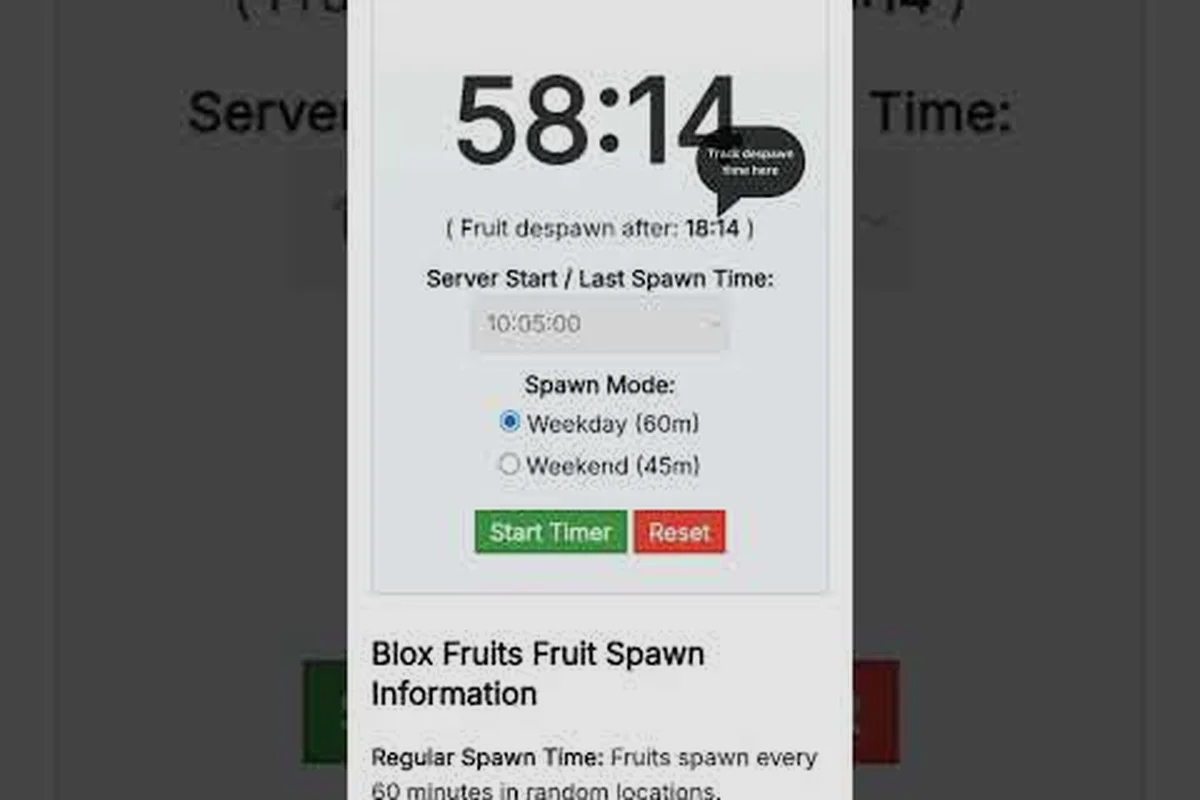
The Blox Fruits fruit despawn time is about 20 minutes, so knowing when fruit appears and vanishes can prevent you from missing a rare spawn. Learn the timing, routes, and restock details that make collecting fruit more efficient.
How Long a Wild Fruit Lasts Before It Vanishes
A naturally spawned fruit remains available for roughly 20 minutes before it despawns. This is the core of the Blox Fruits fruit despawn time, and it explains why a fruit that was visible moments earlier may disappear when you return with a full route or a higher-level requirement. The spawn cycle itself occurs about once per hour, according to the timing reference in this Blox Fruits spawn timer video.
The important distinction is that spawn frequency and fruit lifetime are separate timers. A fruit may spawn on a roughly hourly rotation, but it does not remain collectable for that entire hour. Once it appears, you normally have about 20 minutes to reach it and use or store it before it vanishes.
| Timing element | Approximate duration | What it means for you |
|---|---|---|
| Wild fruit spawn cycle | About 1 hour | New fruit locations may become available on a regular rotation |
| Fruit despawn time | About 20 minutes | A fruit found on the ground will not wait indefinitely |
| Useful response time | Often less than 20 minutes | Travel, fighting, and route mistakes can shorten your window |
| Server restart effect | May reset availability | A quick sweep can be valuable after a restart |
Because the timer is short, finding a fruit is only half the task. Players should plan a route before spawning begins, avoid unnecessary combat, and keep enough movement and combat resources to reach a distant target. The complete fruit list and spawn reference can help you identify which locations and fruit types deserve priority.
Why Fruit Disappears During a Hunt
The 20-minute timer continues while you are fighting bosses, chasing NPCs, or crossing a large island. If you collect the fruit after it has already been standing for several minutes, your remaining window may be much shorter than the full despawn duration. This is especially noticeable when a high-level target blocks the route to a spawn location.
The best response is to treat a visible fruit as an immediate objective rather than a later errand. Server status, fruit location, and your ability to reach it should all be considered before you commit. A fruit that is impossible to reach before despawn is not useful for that cycle, even if it is a rare drop.
Practical Timing Plan
A simple routine can make the wild-fruit system easier to manage. Start by checking whether your character has enough stamina and health for the route, then choose the closest valuable spawn. Use movement abilities and avoid pulling unnecessary fights. If the fruit is still visible but you cannot reach it safely, move on rather than spending the entire window.
Immediate pickup is more valuable than delayed collection, especially when the fruit will be consumed later. Store it promptly if you do not plan to equip it right away, because the physical copy disappears when used. This is also why understanding the difference between a temporary world fruit and a Blox Fruits permanent fruit matters.
Wild Fruit Spawn Locations and Route Planning
Wild fruit does not wait at a single universal location. Spawn points are distributed among the islands and areas where players can explore, and the practical challenge is covering the relevant routes before a fruit expires. Player reports and community testing support a pattern of checking multiple possible locations instead of relying on one fixed spot.
The hourly spawn cycle and 20-minute despawn window create a simple planning rule: spend the first part of the hour preparing, then use the next part collecting. If you wait until the end of a long cycle, you may arrive just as a fruit is disappearing. If you begin immediately, you can work through nearby spawn points while they remain active.
| Route priority | Fruit situation | Best action |
|---|---|---|
| 1 | Rare or high-demand fruit visible | Drop lower-value objectives and go immediately |
| 2 | Common fruit nearby | Collect it if the route remains efficient |
| 3 | Distant fruit with several minutes left | Travel there only if no blockers are likely |
| 4 | Fruit near a dangerous area | Check levels, elites, and boss interference first |
| 5 | No fruit visible | Rotate to another known spawn region |
For a broader list of possible drops, use the Blox Fruits fruit spawn locations and rarity guide while planning. Keep separate notes for beginner-friendly routes, high-level routes, and locations that are risky because of enemies or NPCs. That organization prevents a promising rare fruit from being lost to a preventable navigation mistake.
Route by Island and Objective
Beginner routes should favor short travel distances and low-risk encounters. A small route with several common fruits is usually better than a long route containing one uncertain spawn. As your level increases, you can add locations where stronger enemies or bosses may interrupt the trip, but the timer does not become more generous.
The same logic applies to private-server activity. A group can divide locations and share findings, but every member still needs to respect the physical fruit’s limited existence. If two players target the same fruit, decide which one has the faster route before spending extra time arguing about ownership.
Why Rare Fruit Searches Need Extra Preparation
Rare fruit searches take longer because players often check several possible locations. Before the next spawn, save consumables, collect passive buffs, and identify the most dangerous enemy along the route. Fighting a full wave at every stop can consume the entire despawn window, even when the fruit was visible from the start. Use the following checklist:
-
Confirm the target location is reachable at your current level.
-
Bring healing items for the return trip, not just the fight.
-
Keep movement abilities off cooldown when entering an open area.
-
Avoid claiming a fruit until it is actually visible.
-
Use a nearby spawn when the high-risk target is blocked.
-
Equip or store the fruit immediately after collection.
These habits do not change the timer, but they prevent avoidable time loss. The central fact behind the Blox Fruits fruit despawn time is simple: speed and route quality can determine whether a spawn becomes a usable fruit or a missed opportunity.
Blox Fruits Fruit Dealer Restock and Timers
The Blox Fruits fruit dealer is different from a wild fruit spawn. A dealer sells fruit directly, and its inventory follows a four-hour restock schedule. This makes the Blox Fruits dealer restock timer the key planning window for players who want a specific fruit without relying on random map locations.
The difference is reliability. Wild fruit may appear somewhere and disappear after about 20 minutes, while a dealer can provide a predictable stock refresh every four hours. If you need one particular fruit for a build, checking the dealer is usually more efficient than waiting for a compatible wild spawn.
| Source | Main timing | Availability | Best use |
|---|---|---|---|
| Wild fruit | About 20-minute lifetime | Random spawn location | Quick collection during an active cycle |
| Blox Fruits fruit dealer | About 4-hour restock | Predetermined dealer stock | Targeting a specific fruit |
| Permanent fruit purchase | Purchase-based | Dealer stock and price apply | Long-term ownership |
Reading the Fruit Dealer Timer
Players often search for the Blox Fruits fruit dealer timer because the visible stock can look more urgent than it is. Before traveling, confirm the dealer’s location, the route, and the current inventory. A dealer visit that ends with an empty stock because the item was already purchased may be less useful than waiting for the restock.
The safest approach is to plan around the four-hour dealer restock, not around a vague memory of when you last visited. If you visited shortly before a refresh, use the interval to collect wild fruit, complete quests, or improve your character. When the window arrives, visit the dealer with enough money for the fruit you need.
| Planning moment | Dealer action | Supporting action |
|---|---|---|
| Before restock | Check route and budget | Gather money through gameplay |
| Immediately after restock | Check target fruit | Compare the listed price with your budget |
| If stock is missing | Confirm purchase status | Plan another stock check or wait for refresh |
| After purchase | Equip or store fruit | Avoid leaving it vulnerable to loss |
The exact dealer location and inventory can vary with the game’s current state, so verify information against the live game rather than relying on an old guide. The Blox Fruits dealer restock is still best treated as a four-hour cycle, because that is the dependable timing information players report for the system.
Blox Fruits Permanent Fruit: Ownership, Price, and Differences
A Blox Fruits permanent fruit stays in the player’s inventory rather than disappearing after a short world-spawn lifetime. When a normal fruit is used, it is consumed. A permanent version does not work that way, which makes it much more stable for long-term builds, trading, and progression planning.
The listed Blox Fruits permanent fruit price depends on the fruit and current dealer availability. The game sets the purchase price for permanent stock; it does not allow players to set their own price at the dealer. Player trade values can move differently because physical copies are bought, sold, and negotiated between users.
| Feature | Wild temporary fruit | Blox Fruits permanent fruit |
|---|---|---|
| Lifetime | About 20 minutes after appearing | Persists until sold, traded, or otherwise lost |
| Main source | Random world spawn | Fruit dealer purchase |
| Used fruit | Consumed when equipped or used | Does not disappear through normal use |
| Price basis | Usually obtained without a direct purchase | Set dealer price |
| Trade value | Depends on supply and demand | Often more stable, but still market-driven |
| Best for | Immediate experimentation | Long-term builds and collection goals |
How to Get Permanent Fruit Safely
The process starts with locating the Blox Fruits fruit dealer and checking whether the permanent version of the desired fruit is in stock. Bring enough money before beginning the purchase, and confirm the item name and price in the purchase window. This simple check prevents accidentally buying the temporary version when both forms are displayed near one another.
After purchase, keep the fruit in your inventory until you are ready to use it. If you plan to equip it, make sure it suits your current build. If you plan to trade it, review the trading guide and fruit value information because the dealer price and community trade value are not the same thing.
A Blox Fruits permanent fruit price can feel expensive when compared with a random spawn, but the purchase provides guaranteed ownership instead of a short collection window. That distinction becomes more important for Mythical, Legendary, and other high-value fruits that players want to keep over many sessions.
Temporary Versus Permanent: Which Should You Choose?
Choose temporary fruit when you are testing a new ability, need a quick power spike, or want to avoid spending money. Choose permanent fruit when you already know the build you want, expect to keep using the fruit, or want a reliable copy that will not disappear after use.
The choice also affects trading. A physical fruit used for building is gone, while an unused copy can be evaluated by other players. If a rare fruit seems especially valuable, confirm its condition before making a trade. The trade scam prevention guide explains why condition checks and careful trade review matter.
Comparing Timers and Choosing the Best Fruit Source
The best source depends on whether your priority is speed, certainty, cost, or experimentation. Wild spawns are free when you can reach them, while permanent purchases cost money but remove the 20-minute pressure. The dealer adds predictable restocks but requires planning around a four-hour interval.
| Player goal | Best source | Timing to plan | Main advantage |
|---|---|---|---|
| Try a fruit immediately | Wild spawn | About 20 minutes | No direct purchase required |
| Obtain a specific fruit | Dealer | About 4-hour restock | Predictable availability |
| Keep a fruit indefinitely | Permanent purchase | Dealer refresh | No normal use consumption |
| Fill a temporary build | Either option | Whichever is faster | Flexible progression |
| Prepare a trade | Unused permanent copy | Dealer and trade market | More stable ownership |
A Decision Guide Based on Time Available
If you have only a few minutes and a common fruit is nearby, collect the wild spawn. If you need a specific fruit and the dealer is close to its refresh, wait for the Blox Fruits dealer restock rather than wandering aimlessly. If you have plenty of money but no desire to depend on map events, buy the permanent version when stock is available.
| Situation | Recommended choice |
|---|---|
| Fruit visible and worth collecting | Go before the 20-minute despawn |
| Target fruit unavailable at the dealer | Continue spawning, quests, or farming |
| Target fruit available for permanent purchase | Buy when the price fits your budget |
| Uncertain whether you want the fruit permanently | Start with a temporary copy |
| Long-term build around one fruit | Obtain the permanent copy |
This comparison also shows why the Blox Fruits fruit despawn time is useful without being the only timing number to remember. The game contains several overlapping schedules: world spawns, fruit lifetime, dealer inventory refresh, and your own progression needs. A reliable plan assigns each schedule a purpose rather than expecting one timer to answer every question.
Make Timing Work for Your Schedule
Players who rotate between Blox Fruits activities can use the dealer cycle as an anchor. Spend the first block earning money or improving gear, collect wild fruit during the next block, and revisit the dealer after four hours. This simple routine is often more productive than checking every few minutes without a plan.
Track only the information that changes your decision: dealer refresh, target fruit stock, price, and your approximate route. Player experience suggests that a short, accurate checklist works better than a long list of uncertain spawn rumors. The game can change over time, so treat community timings as current observations and confirm unusual details in-game.
Frequently Asked Questions
How long does a Blox Fruits fruit stay on the ground?
A naturally spawned fruit generally remains available for about 20 minutes before despawning. The spawn cycle happens about once per hour, but those are separate timers. Reach the fruit promptly because travel, combat, and switching objectives can reduce the time you have left.
How often does the Blox Fruits fruit dealer restock?
Dealer inventory refreshes on an approximately four-hour restock cycle. The exact selection and price should be verified in the live game because availability can change. Visit soon after the refresh if you need a specific fruit and have enough money ready.
Can a Blox Fruits permanent fruit despawn like a wild fruit?
No. A permanent fruit remains in your inventory under normal conditions instead of vanishing after the wild-fruit lifetime. A normal fruit is consumed when used, while the permanent version survives normal use. It can still be lost through trading, selling, or other player decisions.
How much does a Blox Fruits permanent fruit cost?
The price varies by fruit and current dealer stock, and the game determines the listed purchase cost. Community trade prices are separate because supply, demand, and condition affect what players accept. Compare the dealer price with your budget before confirming the purchase.
Should I collect a wild fruit or wait for a permanent dealer sale?
Collect a wild fruit when you are nearby and want to test its ability immediately. Wait for the permanent sale when you know the build you want, want guaranteed ownership, or need to preserve an unused copy for trading. Both options can be useful at different stages of progression.